

Attending AMUG 2017 in Chicago, IL, this week, Technology Analyst Dr Bryony Core gained exclusive insight to HP's new Open Materials and Applications Lab and their Materials Development Kit (MDK) for the optimisation of polymer powders for use in additive manufacturing. Announcing a significant milestone in the development of AM-ready polymer powders, HP revealed the steps they are taking with world leading materials companies to improve key factors such as flowability, spreadability and density. Tim Weber, global head of the 3D Materials and Advanced Applications at HP told IDTechEx "By collaborating with world-leading materials suppliers, HP and the community at the Open Materials and Applications Lab are spearheading progress in the manufacture of the most innovative and production-ready polymer powders for 3D Printing".
HP is currently collaborating with BASF and Arkema, also in attendance at AMUG 2017. Arkema told IDTechEx that they were working with HP to develop their Rilsan®, Rilsamid®, Kynar® resins and Pebax® copolymers for use in SLS printers. They stated that the MDK had allowed them to optimise key parameters such as flowability for use in powder bed processes. BASF told IDTechEx that the MDK had allowed them to optimise thermoplastic elastomers such as poly(urethane) and TPU powder for SLS through ongoing collaboration with HP.
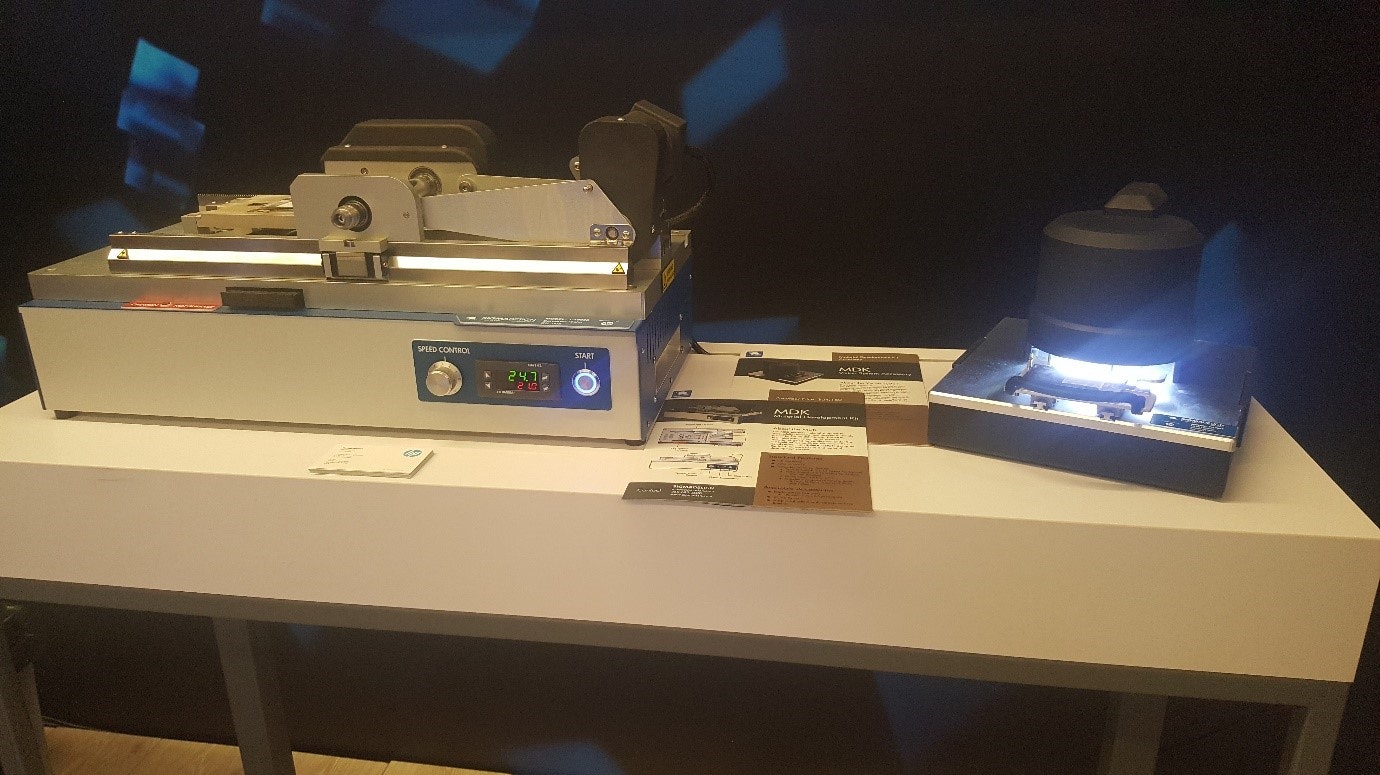
The MDK and Optical Scanner demonstration at AMUG 2017. Source: IDTechEx photo
HP's MDK tool operates by allowing materials manufacturers to probe parameters such as flowability with small quantities of material (<10g). The powder is then inspected with an optical scanner to monitor the powder's optical density and uniformity. These parameters are input into a spreadsheet which allows for rapid, high-throughput testing of multiple powder morphologies and compositions whilst giving materials suppliers the convenience of testing their powders on site.
Once a high performing powder has been identified, a batch of material is sent to the HP Open Materials and Applications Lab on site in Corvallis, Oregon. Here, larger quantities of material are tested for performance during sintering, and subsequent macroscopic properties such as tensile strength, Young's modulus and elongation at break. If the powder meets specifications at this point, the powder is probed for its flowability in the build unit, before large quantities (<500 kg) are finally tested in their Multi Jet Fusion printers. Mike Monroe, 3D Printing R&D engineer at the Open Materials and Applications informed IDTechEx that powders optimised for the Multi Jet Fusion printer could be recycled with the addition of 20% by weight new powder as the use of IR to sinter powder particles together ensured that powder longevity was maintained. This is in contrast to alternative SLS processes that are currently available, in which powder morphology distortion is par for the course as a result of the laser sintering technology.
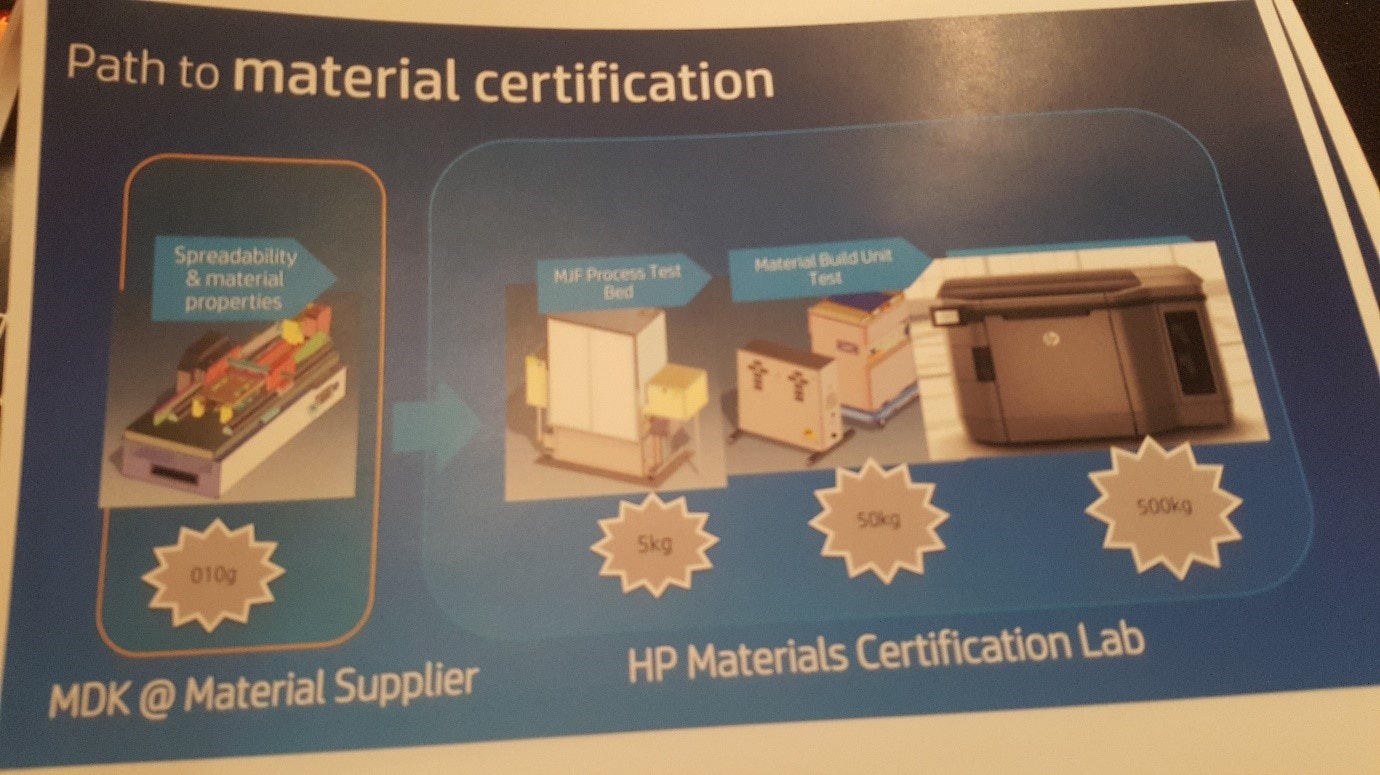
The HP Open Materials and Applications Lab process. Source: IDTechEx Photo
Tim Weber closed by alluding to what we can expect to see long term with this program: "We are currently developing the fabrication of functional polymer nanocomposites in which agents such as dyes and conductive agents are interspersed with a polymer on the voxel level, enabling modification of properties such as colour, texture, elasticity and conductivity".
